
Big Ideas, Real Impact.
Every event we host is designed with intention, from the atmosphere we create to the way each session flows.
Register today for our intensive half-day session.
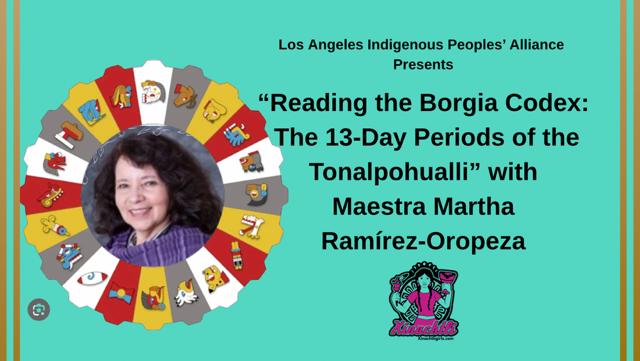
“Reading the Borgia Codex: The 13-Day Periods of the Tonalpohualli”
Dear Colleagues and Culturally Grounded Practitioners,
You are cordially invited to a rigorous, foundational seminar within the Xinachtli Curriculum. This session is designed for professionals seeking to deepen their praxis through ancestral Mesoamerican frameworks—specifically, the Tonalpohualli as a living, operational model for character development and psychosocial resilience.
Facilitated by: Maestra Martha Ramirez-Oropeza, Chicana elder and scholarly practitioner.
Central Framework: This seminar transcends historical artifact analysis. We will engage the Codex Borgia—a Post-Classic Mesoamerican amoxtli—as a methodological tool. The focus is the 20 trecenas (13-day periods), examined not as relics, but as dynamic maps of spiritual timing, energetic flux, and developmental archetypes.
Learning Objectives:
Glyphic Literacy: Acquire a functional competence in reading Toltec glyphic systems as they appear within the Borgia.
· Trecena Interpretation: Discern the distinct energetic signature and character lesson embedded within each 13-day cycle.
· Applied Cosmology: Understand the Tonalpohualli’s 260-day count as a diagnostic and prescriptive framework for identity formation in youth and community contexts.
Core Proposition:
The Tonalpohualli offers a radical pedagogical truth for the populations we serve: You are not a problem to be solved, nor a blank slate. You are a specific melody, born from a specific convergence of forces. Character development is the disciplined practice of learning to play that melody with awareness, humility, and precise timing.
Outcomes: Participants will exit with applied glyph literacy, interpretive competence for the trecena, and a sophisticated understanding of how pre-Columbian ontological frameworks inform contemporary identity formation and soul-rooted practice.
Methodology: Guided reading and hermeneutic analysis of the Codex Borgia.
Invitation: This session is intended for Xinachtli facilitators and allied professionals (mental health, education, youth development) who center ancestral knowledge as a legitimate, rigorous, and usable intervention.
Register today for this half-day session.
Leer los glifos. Decodificar las trecenas. Construir carácter desde adentro hacia afuera.
Academic Context:
The Codex Borgia, a pre-Columbian screenfold manuscript from the late Post-Classic period (c. 1250–1521 CE), preserves the Tonalpohualli—not merely as a temporal count but as a cartography of the soul. It posits that each individual carries a distinct tonalli (life-force/destiny-seed) aligned with one of 20 day-signs. Within this paradigm, character development is not remediation of deficits but precise calibration to one’s innate energetic signature.
This is not abstraction. This is applicable, evidence-informed ancestral methodology.